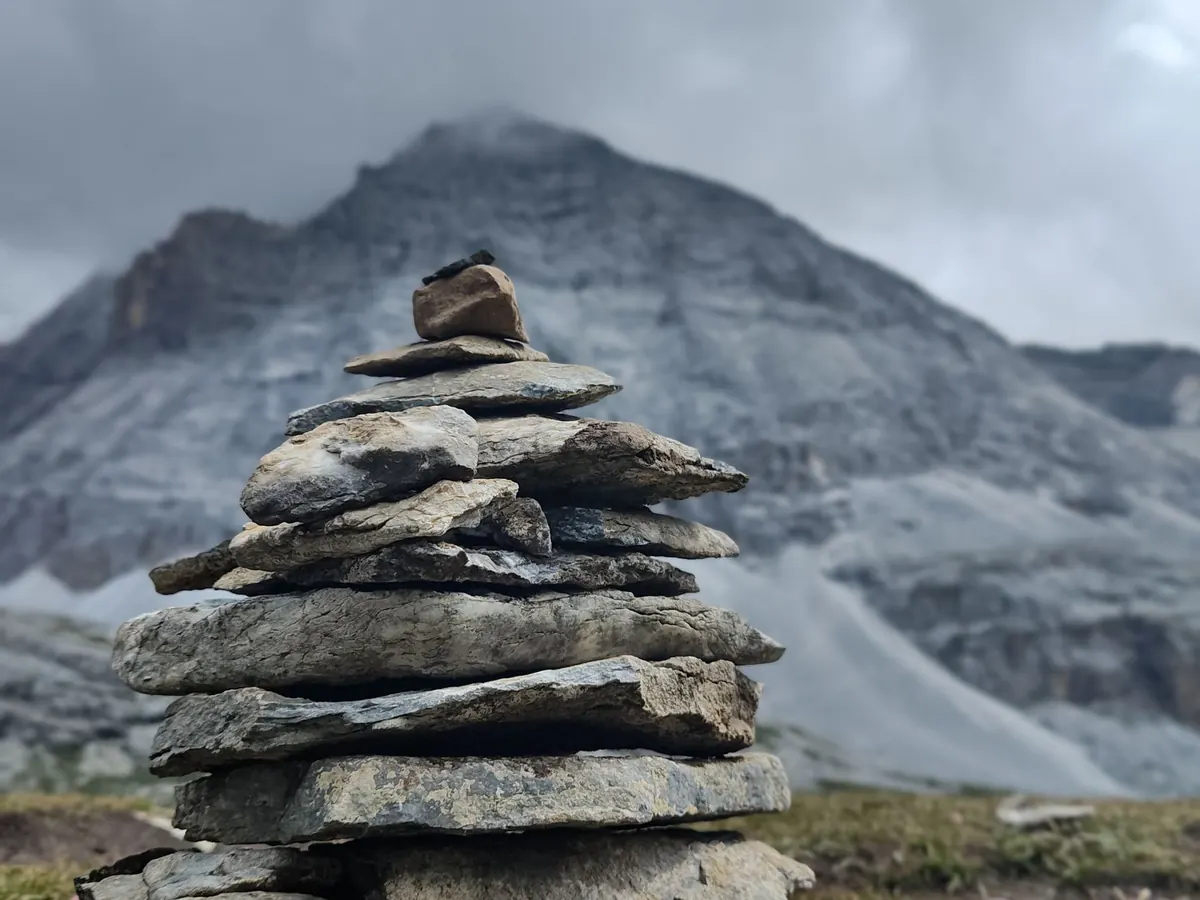
A line of stones on a Highland ridge. A squat pile beside a Lakeland path. A weather-beaten heap on a Cornish cliff top. Cairns turn up all over the British uplands, and most walkers pass dozens without a second thought. They deserve a second thought. Some are several thousand years old and protected by law. Others were stacked by someone with cold hands and good intentions last Saturday. Knowing which is which changes how you read a path — and what you leave behind.
What a Cairn Actually Is
The word comes from Scottish Gaelic càrn, and its Welsh cousin carnedd survives in names such as Carnedd Llewelyn and Carnedd Dafydd in Eryri. At its plainest, a cairn is a deliberate pile of stones. At its most varied, that definition covers a waymark you could knock over with one boot and a chambered tomb the size of a small hill.
Purpose is what separates the useful from the superfluous. Three broad types appear on UK trails:
- Waymark cairns — small, often in pairs or short lines, marking a route across open ground where no obvious path survives.
- Summit cairns — larger piles on the top of a hill, sometimes with a windbreak wall attached, and generally shown as a cairn symbol on Ordnance Survey maps.
- Monuments — prehistoric burial cairns, boundary markers and memorials, many of them scheduled and legally protected.
Then there is a fourth category, and it is the one causing trouble: the cairn built by a walker for no particular reason, usually at a summit or a viewpoint, usually out of stones that were doing a job somewhere else.
From Burial Mounds to Waymarks: A Short History
The oldest cairns are prehistoric. Across the uplands of Britain and Ireland, Neolithic and Bronze Age communities raised cairns over their dead — sometimes as communal tombs with chambers inside, sometimes over one person. Many were later opened, robbed or flattened, leaving a low spread of stones that a tired walker might easily mistake for natural scree. The Grey Cairns of Camster in Caithness and Maeshowe in Orkney sit at the grand end of that tradition; the small, hummocky cairns scattered over Dartmoor and the North York Moors sit at the modest end.
Later centuries gave cairns new jobs. Boundary cairns marked the edges of parishes and estates, some of them walked in the annual beating of the bounds. Drovers, miners and packhorse travellers piled stones to mark fords, pass crossings and the firmest line over boggy ground. By the Victorian era, cairns were being built to remember people and events: a landowner, a climbing accident, a lost aircrew.
The cairns you meet on a modern path are the newest layer in that story — and the only layer still growing.
How Cairns Help You Navigate
A good cairn does something a path cannot: it survives when the ground is too hard, too wet or too high to hold a track. That makes it useful in specific conditions.
- On featureless moorland and plateau tops, where the path fades to a smear in the grass.
- In hill fog, when a cairn confirms you are still on the line you thought you were following.
- In winter, when paths are buried and only the top of a cairn breaks the snow.
- At tricky crossings, where a pair of cairns shows where a route enters and leaves a bog, a scree slope or a stream.
- On eroded ridges, where braided paths make it hard to tell which line is the main one.
Used that way, a cairn is confirmation, not instruction. It tells you that somebody once thought this was the way. On its own that is weak evidence, which is why the map and compass still come first.
When a Cairn Sends You the Wrong Way
Cairns mislead in predictable ways. A walker builds one at the point where they turned round, and the next person follows it off the true line. Someone piles stones on a false top and creates an imaginary summit that has fooled generations. Two cairns sit on the same ridge, one genuine and one not, and in mist you cannot tell whether the cairn ahead is the one behind you.
There are worse versions. Cairns get built near cliff edges and above loose, eroded ground, quietly inviting people onto the least safe part of the hillside. Others sit on a line that was sensible in dry weather and is a knee-deep bog after rain.
Here is the rule worth remembering: if a cairn disagrees with your map and compass, and you are confident of your bearing, trust the bearing. If you are not confident, that is the real problem — stop, eat something, get out of the wind and work out where you actually are before you follow anything.
Why Building New Cairns Does Real Damage
It feels harmless. It is not, and the reasons stack up.
- The stone has to come from somewhere. Lifting stones from a path edge loosens the surface, exposes peat and speeds up erosion. Peat that took centuries to form does not come back quickly.
- Some cairns are protected. Many are scheduled monuments, and interfering with one can be a criminal offence. Even where nothing is scheduled, moving stones can disturb archaeology you cannot see.
- Stone piles are habitat. Scree, boulder fields and drystone walls support invertebrates, mosses and nesting birds such as wheatear and ring ouzel. Stripping stones out of them has consequences further down the food chain.
- The effect is cumulative. One cairn becomes five, then fifty. National park authorities and the National Trust ask visitors not to build them, and rangers spend time dismantling them.
- It changes what the hills feel like. A summit scattered with small piles looks less like a mountain top and more like a car park.
Equally, do not knock cairns down because you disapprove of them. Some are genuine markers, some are historic, and dismantling the wrong one is as damaging as adding to it. If a cairn looks misplaced or a pile has appeared where it should not be, report it to the national park authority, the National Trust or the relevant heritage body and let them decide.
What to Do Instead
If you want to navigate confidently without leaning on cairns, build the skills that work in any weather.
- Learn to set a map and take a compass bearing. Practise on a familiar hill in good weather, not on an unfamiliar one in fog.
- Take bearings before you need them — at a junction, a summit or the moment a path starts to fade.
- Use timing and pacing. Note the time you leave a known point and estimate how long the next leg should take in the conditions you have, not the ones you hoped for.
- Use natural handrails: a stream, a wall, a fence line, a ridge crest. Follow them deliberately rather than drifting along them.
- Carry a paper map and compass as your primary tools, with a phone or GPS as backup and a way to keep it charged.
- If marking a place matters to you, drop a pin, take a photograph or write it in a bothy book. Keep the hill as you found it.
Practical Takeaways for Your Next Walk
Treat any cairn as a clue, never as an instruction. Note it, check it against your map, and carry on. Leave every cairn as you found it: do not add stones, do not rearrange them, do not pull them apart. If you are walking on a scheduled monument, keep to the path, because the stones beneath your feet may be older than anything else you see all day.
Plan your day with turning points and escape routes, tell someone where you are going and when you expect to be back, and be honest about your navigation skills. Conditions in the UK hills change fast, and a misty ridge is no place to learn compass work from scratch. Many national park centres, mountaineering clubs and outdoor centres run navigation courses, and a day spent on one is worth more than any number of stones piled by strangers.
The cairns that matter most are the ones that have been there longer than any of us. They are not ours to add to.
Photo: John Maverick / Pexels