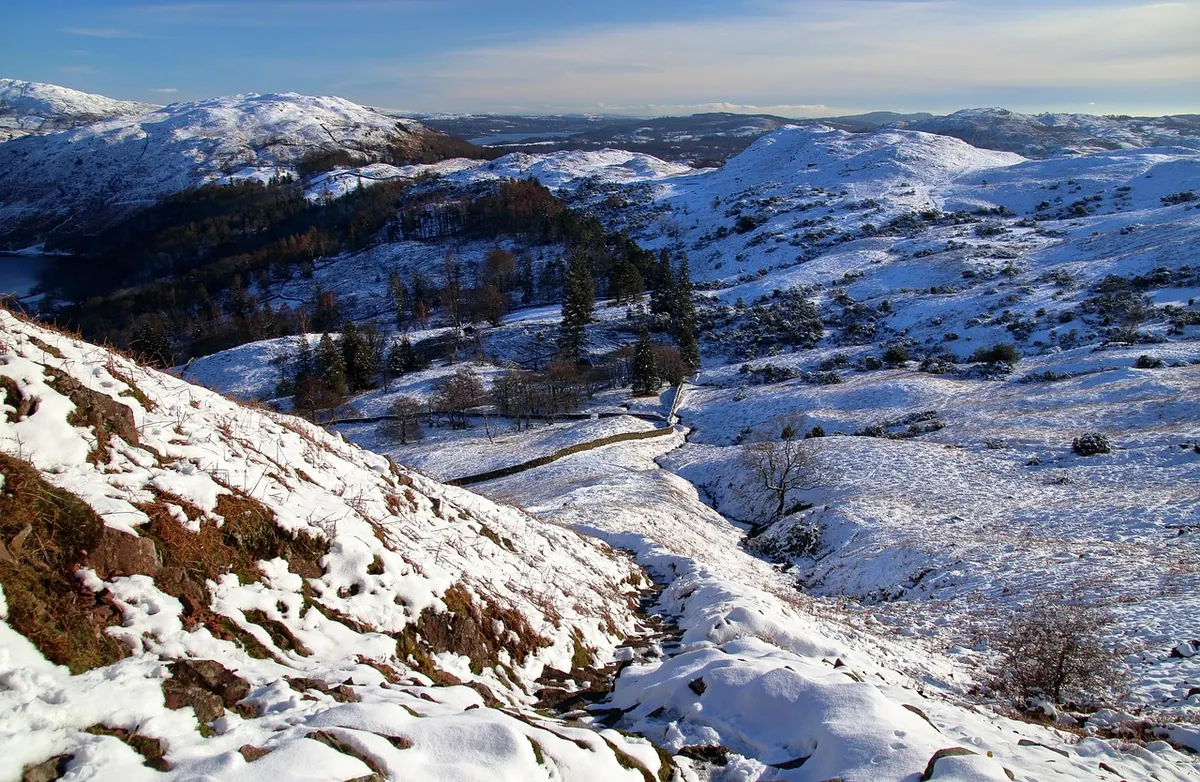
Winter walking in the Lake District is a different discipline from the summer version. The fells are still there, but the light is not. In late December you can be walking in dusk by half past three, and the tops will often be in cloud, in ice, or in a wind that makes a nonsense of your carefully made plans. The answer is not to stay at home. It is to drop into the valleys and the low fells, where paths are sheltered, the going is easier underfoot, and four hours out still feels like a proper day.
What follows are five low-level routes that work well between November and February. All have straightforward access, clear paths, and at least one obvious way of cutting the day short if the weather turns or your legs have had enough.
What Makes a Good Winter Route in Lakeland
Before the routes themselves, it is worth being clear about what you are looking for at this time of year. The best winter days are usually built around a few simple features:
- Low altitude, and a route that stays below the snow line rather than crossing it.
- Paths that drain well and are not so steep that a frost turns them into a luge run.
- A clear turnaround point — a bridge, a tarn, a viewpoint — so you can shorten the day without retracing miles.
- Something to look at even when the cloud is down: water, woodland, valley floor, a bit of industrial history.
Even at a hundred metres, shaded paths can hold ice for days after a hard frost. A pair of microspikes and a set of poles earn their place in the pack from November onwards.
Buttermere Shoreline: The Classic Low-Level Circuit
Start: Buttermere village or Gatesgarth. Distance: about four and a half miles, roughly two hours at a winter pace.
The circuit of Buttermere is the benchmark for low-level walking in the Lakes, and it is arguably at its best in winter, when the crowds have gone and the water is high and grey. Walk it either way. Clockwise from the village takes you south along the western shore beneath the trees, with Fleetwith Pike and Haystacks looming above and the steep flanks of High Stile falling straight into the water on the far side.
Near the northern end, just south of the village, the path passes through a short tunnel cut through a spur of rock. It drips, it is dark, and it is oddly memorable. One warning: after prolonged rain, the shoreline path can be under water in places. If the lake is lapping over the path, turn back rather than wade. The road along the northern shore gives you a straightforward alternative.
Rydal Water and Grasmere: Woods, Water and a Cave
Start: White Moss Common car park on the A591, between Ambleside and Grasmere. It is small and fills quickly, so arrive early or be prepared to park in Grasmere and walk in. Distance: two to four miles depending on how much you add.
The basic loop around Rydal Water is short enough for the shortest day of the year, and the north shore path climbs a few steps to Rydal Cave, a slate quarry cavern with a wide mouth that swallows the light. It is a good place to stop, eat something and listen to the drips.
If you have more time and the weather is kind, carry on to Grasmere along the old church path — the coffin route — which links Rydal to Grasmere via Dove Cottage. It is undulating but never steep, and it drops you into the village for a late lunch. From there you can return the same way or along the road past the lake. St Oswald's churchyard, where Wordsworth is buried, is a two-minute detour from the centre.
Tarn Hows and Yew Tree Tarn: Big Views, Small Effort
Start: the National Trust car park at Tarn Hows, off the A593. Distance: about a mile and a half for the tarn circuit.
Tarn Hows is a Victorian creation — a modest bit of moorland dammed and planted to make a picture — and it works. The circular path is largely level and partly surfaced, making it one of the most reliable options when everything higher up is in cloud. On a clear day you get Coniston Old Man, Wetherlam and the Langdale Pikes all in one sweep.
The catch is ice. Because the path is so well made, it holds frost long after the roads have cleared, and the slopes on the far side get slippery. Take it slowly, and consider spikes if there has been a hard freeze. Across the A593, Yew Tree Tarn is a ten-minute wander with a bench and a view, and it makes a pleasant addition rather than an expedition.
Keswick and Derwentwater: Walks from the Town
Start: Keswick town centre or the car park at the Theatre by the Lake. Distance: anything from half a mile to five.
This is the most flexible option in the Lakes for a short winter day, because you can start from a town with cafes, toilets and a bus service. The shore path south from the theatre to Friar's Crag takes twenty-five minutes at a stroll and gives you one of the finest lake views in England, straight down Derwentwater towards Borrowdale and the jaws of the valley.
Carry on through Cockshot Wood to Strandshag Bay and the Hundred Year Stone, then along the western shore towards Great Wood and Brandelhow. The Keswick launch runs a reduced winter timetable, so check sailing times at the jetties or the tourist information office before you plan to walk out and sail back. If in doubt, treat it as an out-and-back and set your own turnaround time.
A short alternative
Castlehead, the wooded knoll behind the town, takes fifteen minutes of steady climbing and delivers a view over Keswick, the lake and the surrounding fells. It is ideal when you have arrived late, the cloud is low, or you simply want a leg-stretch before dinner.
Elterwater and the Brathay: The Quiet Valley
Start: Elterwater village or Skelwith Bridge. Distance: about two miles for the riverside there-and-back.
The path along the River Brathay between Elterwater and Skelwith Bridge is flat, sheltered and rarely busy in winter. Skelwith Force is modest but genuinely impressive in spate, and the view up Great Langdale from the footbridge at Elterwater gives you the drama without any of the effort.
Loughrigg Terrace, if conditions allow
If the paths are clear of ice and you have a full morning, the climb from Pelter Bridge to Loughrigg Terrace is worth it: a steady pull of around two hundred metres onto a balcony path above Grasmere, with Helm Crag and the valley laid out below. It is straightforward in summer and decidedly less so after a freeze. Do it in daylight, take poles, and be willing to turn around at the first glazed section rather than pressing on to the summit.
Rule of thumb for a winter day: name your turnaround point before you set off, and stick to it even if the weather is better than forecast.
Practical Winter Planning
Short days are manageable if you plan them properly. A few habits make the difference between a good outing and a long, cold walk back in the dark:
- Check the sunset time for your location, not for your home town, and aim to be back at the car at least thirty minutes before it. In midwinter in the Lakes, that means finishing by around half past three.
- Carry a headtorch with spare batteries, even on a two-hour walk. Phones die quickly in the cold, so keep yours in an inside pocket.
- Take a paper map and compass as well as a phone. Paths that are obvious in summer can be hard to follow under leaf litter, standing water or a dusting of snow.
- Pack for the worst, not the forecast: spare gloves, a warm hat, a flask and a waterproof that actually works.
- Tell someone your route and expected return time, and message them when you are down.
- Expect reduced winter opening at cafes, toilets and car parks. Carry your own food and water rather than relying on finding somewhere open.
If you are new to hill walking, or you have a heart, lung or joint condition that might affect you on a cold day, take advice from your GP or a qualified mountain leader before choosing anything more ambitious than a valley path. And if something goes wrong, call 999, ask for the police, and request mountain rescue.
Above all, adjust your ambitions to the season. A low-level circuit in flat light, with the cloud sitting on the tops and nobody else on the path, is one of the genuine pleasures of a Lake District winter. Save the summits for the long days, and enjoy the valleys while the light is short.
Photo: Emphyrio / Pixabay